
360 Degree Feedback
360 Feedback + OKRs: Powerful Duo for Employee Growth
October 20, 2025

In boardrooms around the world, one conversation keeps resurfacing: How do we balance performance accountability with employee growth in a way that’s both scalable and human?
Traditional annual reviews are losing relevance. Today’s workforce, shaped by hybrid models, cross-functional collaboration, and rapid strategy shifts, demands something more dynamic. And that’s where the combination of 360-degree feedback and Objectives & Key Results (OKRs) comes into play.
Together, they form a growth engine, a continuous loop of insight and action that has the power to redefine how companies build leaders, drive alignment, and retain top talent.
Before we dive deeper, let’s pause and ask:What if performance management wasn’t just about tracking goals or giving feedback, but about creating a continuous growth loop?
- That’s exactly what happens when you combine 360-degree feedback with Objectives & Key Results (OKRs). But first, let’s unpack what each one really means.
What is 360-Degree Feedback?
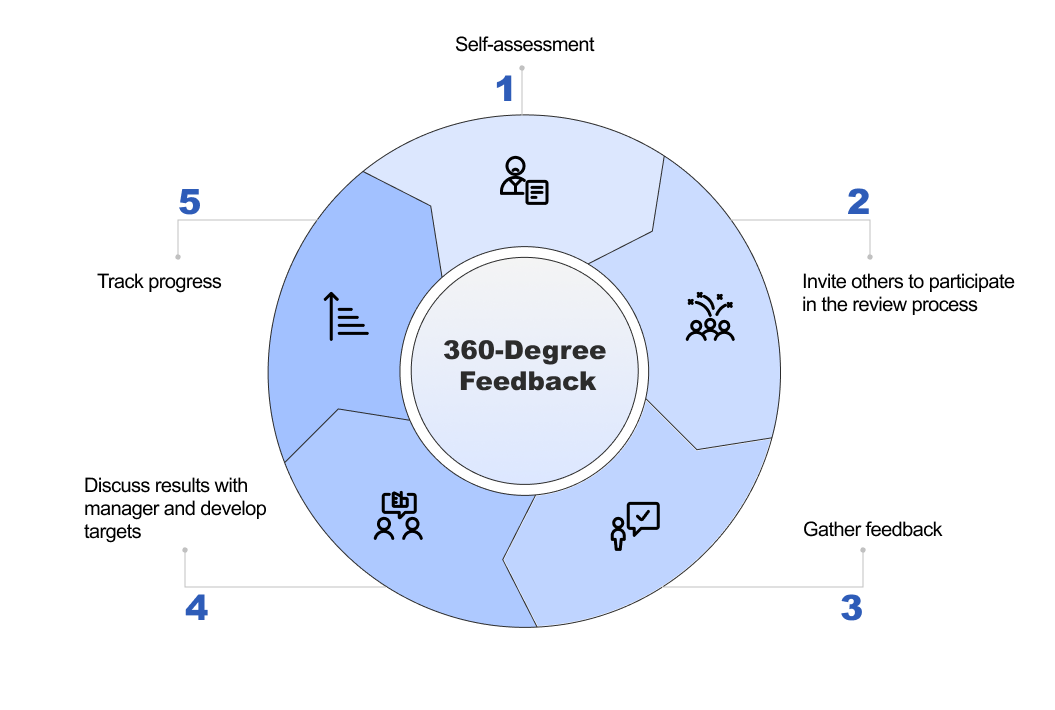
Imagine seeing yourself through the eyes of your peers, managers, direct reports, and sometimes even clients 360-degree feedback is a multi-perspective review system that reveals how you're truly showing up across the organization. It’s not just about performance, it’s about perception, influence, and leadership potential.Done right, it becomes a mirror for growth, not a magnifying glass for flaws.
What are OKRs?
OKRs (Objectives and Key Results) are more than just goal-setting, they’re a strategic compass.They align individual ambition with organizational purpose, turning vague intentions into measurable outcomes.Think of OKRs as the GPS for your team: everyone knows the destination, the milestones, and how fast they’re moving.
How 360 Feedback and OKRs Work Better Together
Individually, both tools are powerful. Together, they close the most common gaps in performance management.
360-degree feedback answers the “how” of performance
How am I leading?
How am I collaborating?
How am I perceived by others?
OKRs answer the “what” and “where”
What am I working toward?
What does success look like?
Where should my effort be focused?
When feedback insights directly inform OKRs, employees don’t just receive input—they act on it.
Development areas identified in 360 feedback translate into focused OKRs. Strengths highlighted through feedback become opportunities for bigger ownership and impact.
This is where growth stops being abstract and becomes intentional.
Why 360-Degree Feedback Matters More in 2025
For experienced HR leaders, 360-degree feedback isn’t new. But its role has evolved. In a distributed and diverse workforce, it is no longer just a developmental tool, it’s a lens into organizational culture.
When done right, 360s help leaders answer tough questions:
- Are managers really empowering their teams, or just delegating tasks?
- Do employees see collaboration as a lived value or a buzzword?
- Where are the hidden leadership gems, those who may not speak loudest but make the biggest-impact?
A study published in the Journal of Management Development highlighted that 360 feedback builds lasting self-awareness and leadership capability when positioned as developmental rather than punitive. And U.S. companies that invest in multi-rater feedback often see faster leadership pipeline growth, an urgent need as over 70% of organizations report a shortage of ready-now leaders.
Why This Matters Now
The U.S. talent market is shifting fast. Gallup’s 2025 Workplace Report states only 21% of employees feel strongly aligned with their company’s goals. At the same time, burnout levels are at record highs, with many workers citing unclear expectations and a lack of growth as their top frustrations.
By integrating 360 feedback with OKRs, HR leaders can tackle both challenges head-on:
- Employees gain clarity (through OKRs).
- Employees feel heard and developed (through feedback).
This dual approach doesn’t just improve performance metrics with it strengthens engagement, retention, and culture, the very levers HR leaders are measured on.
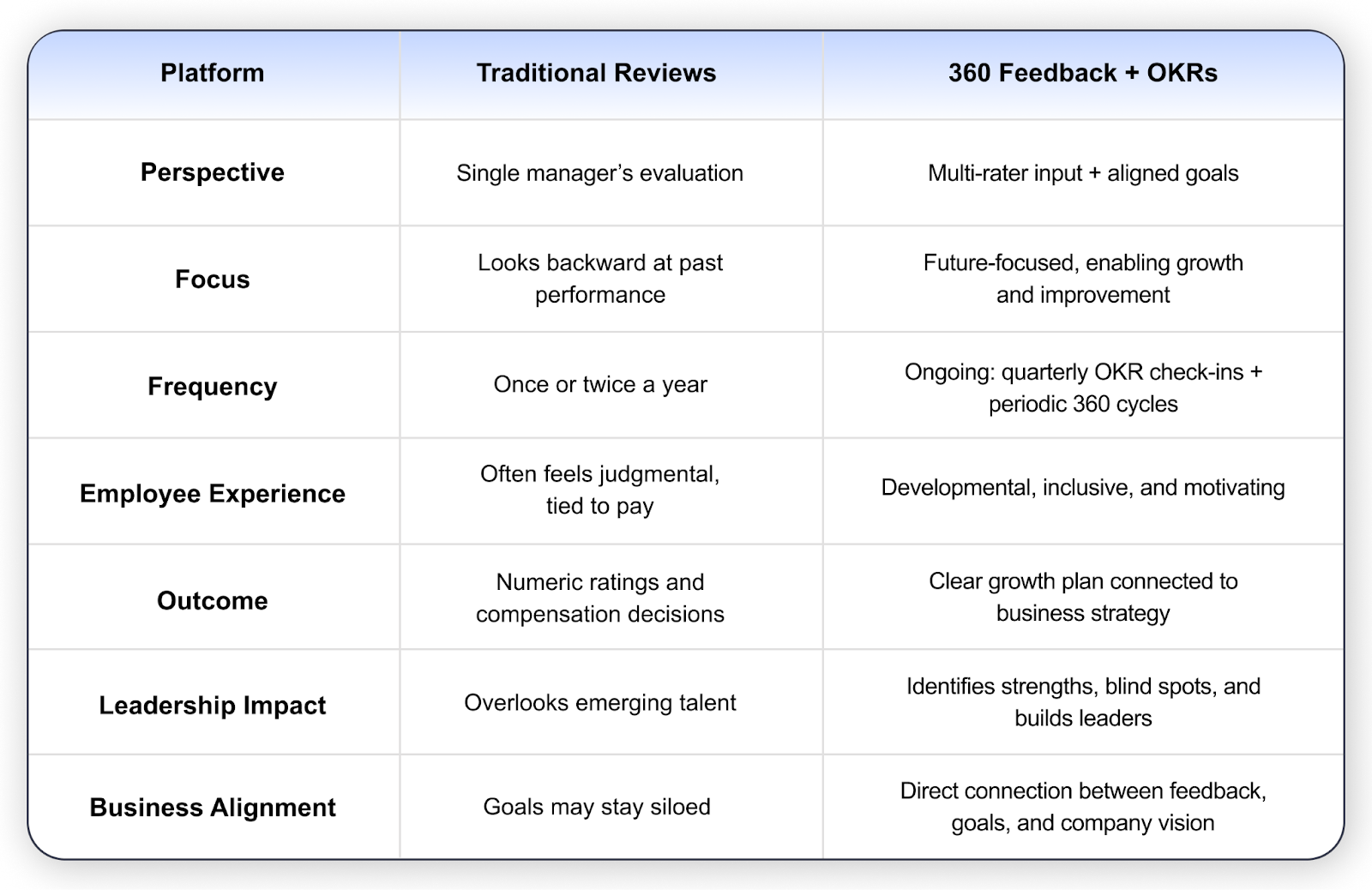
Traditional Reviews vs. 360 Feedback + OKRs
Best Practices for 360-Degree Feedback
To make 360-degree feedback truly effective, HR leaders should focus on a few essentials:
- Secure leadership buy-in – Ensure managers and stakeholders champion the process.
- Define success clearly – Track outcomes like survey completion, action plans, and visible behavior change.
- Act on feedback – Follow-ups, coaching, and OKR alignment turn insights into real growth.
- Keep it relevant – Tie questions to core competencies and business priorities.
- Build accountability – Make employees and managers jointly responsible for using feedback.
- Encourage participation – A 360 works best when it’s consistent and inclusive.
Done well, 360 feedback isn’t just a survey, it becomes a growth engine that fuels employee development and business performance. (Atwater & Waldman,).
Turning Insight Into Growth
For HRBPs, senior HR leaders, and HR managers worldwide, the message is clear:
360 feedback without OKRs risks becoming insight without action.
OKRs without feedback risk becoming goals without meaning.But together, they create something far more powerful—a continuous growth loop where clarity fuels performance, and feedback fuels development.
The future of performance management isn’t about choosing between accountability and growth. It’s about weaving them together.
And the 360 Feedback + OKR framework offers a practical, human-centered way to do exactly that—helping employees grow while helping organizations perform at their best.